How dependent is your Life on Your Ability To Continue Earning?
180 job applications, zero offers, 12 months.
This is the story of Steven Neo, a senior programme manager whose retrenchment story was featured on CNA's article Degree holders may need to rethink job security assumptions as retrenchment patterns shift, say experts.
He was a senior programme manager with a Master's degree and 25 years of experience, working at a large tech firm. His story is the classic Singapore dream where you are sold the script to work hard, get a good degree, get married with a kid and eventually enjoy a senior title at work. Life was good.
Then at 46, he got retrenched.
I put myself in Steven's shoes for a moment and imagined what he had to go through...
Month 3: still okay. I'll find something soon.
Month 7: dipped into his savings he set aside for retirement. Something he told himself not to touch...
Month 11: started calculating how many months before we have to make a decision about liquidating assets.
The mortgage payments didn't pause, the daughter's enrichment classes didn't pause, the household expenses didn't pause as well...
Only his income did.
What fuels our risk appetite during our working years?
Most high income earners never really sat down to digest what truly fuels their risk appetite.
They take on bigger mortgages, commit to aggressive investment portfolios and alternative investments, enjoy lifestyle inflation. Some might not even see these big ticket purchases as risk. In their minds, the income feels permanent and thus so is their quality of life.
Yet, the loss of income risk is a real concern among 6 to 7 figure earners. Their courage to take on huge commitments is fueled by their income. In fact, I've heard many grouse about job unhappiness and stress over their job yet can't quit because they want to preserve the lifestyle.
So when involuntary loss of income happens, it can come as a shock and force a major lifestyle adjustment. Usually this unexpected occurance can happen in 2 forms - through a death or illness and retrenchment.
Does your portfolio prepare you through your 4 adult phases?

Phase 1: Income Dependence
Between our early 20s to 30s, our active income funds every aspect of our lifestyle. Our first house, our food, our transport, our hobbies and our holidays. This is the accumulation phase where we are trying to build assets for wealth creation. At this phase, the fear of retrenchment risk and not finding another job is low. On the other hand, what can potentially derail our plans is health risk.
This is the phase where it is the most crucial to protect our income because it's the only source. There's no savings available to self insure against risk and even if there is savings, it's likely the least substantial across life stages. That's why it's important to protect our inability to work due to sickness.
Phase 2: Income Builds Wealth
As our income grows, we start catering our surplus towards building our wealth while still enjoying our lives. High income earners can fully maximize their earning power to build a secondary income engine to subsidize their lifestyle. Starting early enables longer compounding and accumulation towards a sizeable lump sum that can eventually generate an income that can pay for some parts of your lifestyle.
Phase 3: Income + Wealth
If done right, there would be a decent lump sum by early 40s to 50s. This first serves as a cushion against retrenchment risk. It also serve a secondary function of creating cashflow if needed since the lump sum should be at least a respectable mid 6 figures amount by then. Cashflow is crucial for life transitions like job changes or an conscious choice to slow down.
Phase 4: Financial Freedom
By now the income becomes a 'good to have' not a must have. Active income dependency should no longer be a worry and instead work becomes a choice not a necessity. This is also what is defined as retirement planning done well.
An outdated portfolio causes failure
The is where the blindspot of most high income clients occur. Most don't update their portfolio architecture. They may have done a round of planning at 32 and the same portfolio is now supporting their needs at 45.
This could translate to income protection from illness on old salaries. It might also mean the client stays in income dependence phase without transitioning into wealth creation. Naturally there won't be a safety net or alternative income to insure the lifestyle against any loss of income when one's career becomes more senior.
If left unsolved, the problem gets scarier with age. Because the entire lifestyle is still dependent on only 1 income source. That income source cannot afford to fail.
Good planning reduces income dependence overtime
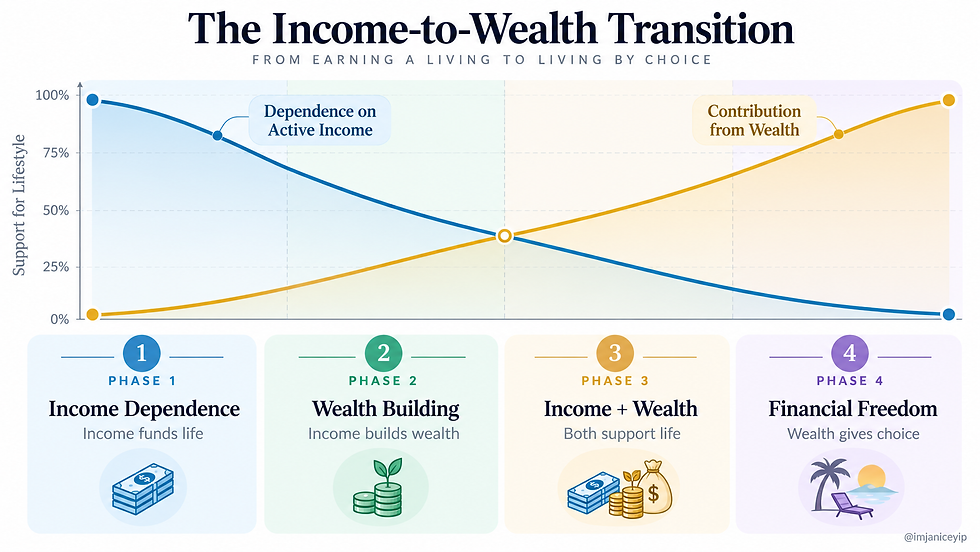
A good planning architecture would cater for the capacity of your financial portfolio to evolve from being fully dependent on an active income to one which eventually can sustain without it.
The design of the portfolio entails considering different life stage needs and risks. It's easy to set up an ideal portfolio but life don't move in a linear direction. It's important to consider the potential pitfalls that would throw the entire game plan off course.
No point planning if the plan only works based on the most optimistic permutation.
We all deserve an all weather strategy
When I reflect on the conversations with my high income clients, I notice the 2 recurring themes that recur because of the high income.
One group might believe that they are unlikely to fall ill hence put on income protection insurance needs or believe they can self insure.
Another group heavily insures while focusing on their high income paying jobs without building the infrastructure in place to provide themselves with the optionality not to work.
An all weather strategy should encompass both considerations. It should evolve as you grow too.
That's the food for thought I wish to leave you with in this post.
If you want to also be hand-held through our flagship GTR Approach to create an all weather strategy for yourself, feel free to reach me by dropping me a message.
Be sure to share the article if you feel this information is helpful. You will enable a lot more people to learn about education planning.
About Janice
I specialize in identifying and eliminating structural retirement risks for high-income professionals who already think they’re doing enough.
Clients look for me primarily to outsource their retirement planning needs so that they can focus on other aspects of life that interests them. Many of whom are very good in earning their incomes in their respective professions and wish to ensure their monies continue to work harder while they focus on what they are good at. Refer to client testimonials here.
Disclaimer: The content created are based on my personal opinions and may not be representative to everyone or any organisation. If you have any doubts or queries pertaining to insurance or investment, please seek professional advice from a trusted adviser in an official setting. You may also reach out to me if you do not have a present adviser using the message box under 'Let's Talk'.


Comments